End shadow AI by making the sanctioned path better.
Blocking consumer AI tools does not stop people using them. It stops them telling you. The fix that lasts is a sanctioned option people prefer, which you govern from one admin console instead of nine.
- Company data in consumer AI tools, discovered by accident
- A new AI vendor to assess every month, each with its own review
- No way to answer 'which models are our people using' with evidence
Six things IT & security teams use this for.
Not an exhaustive list. These are the ones that come up first, and the ones that make the case for the rollout on their own.
Controls you can watch working.
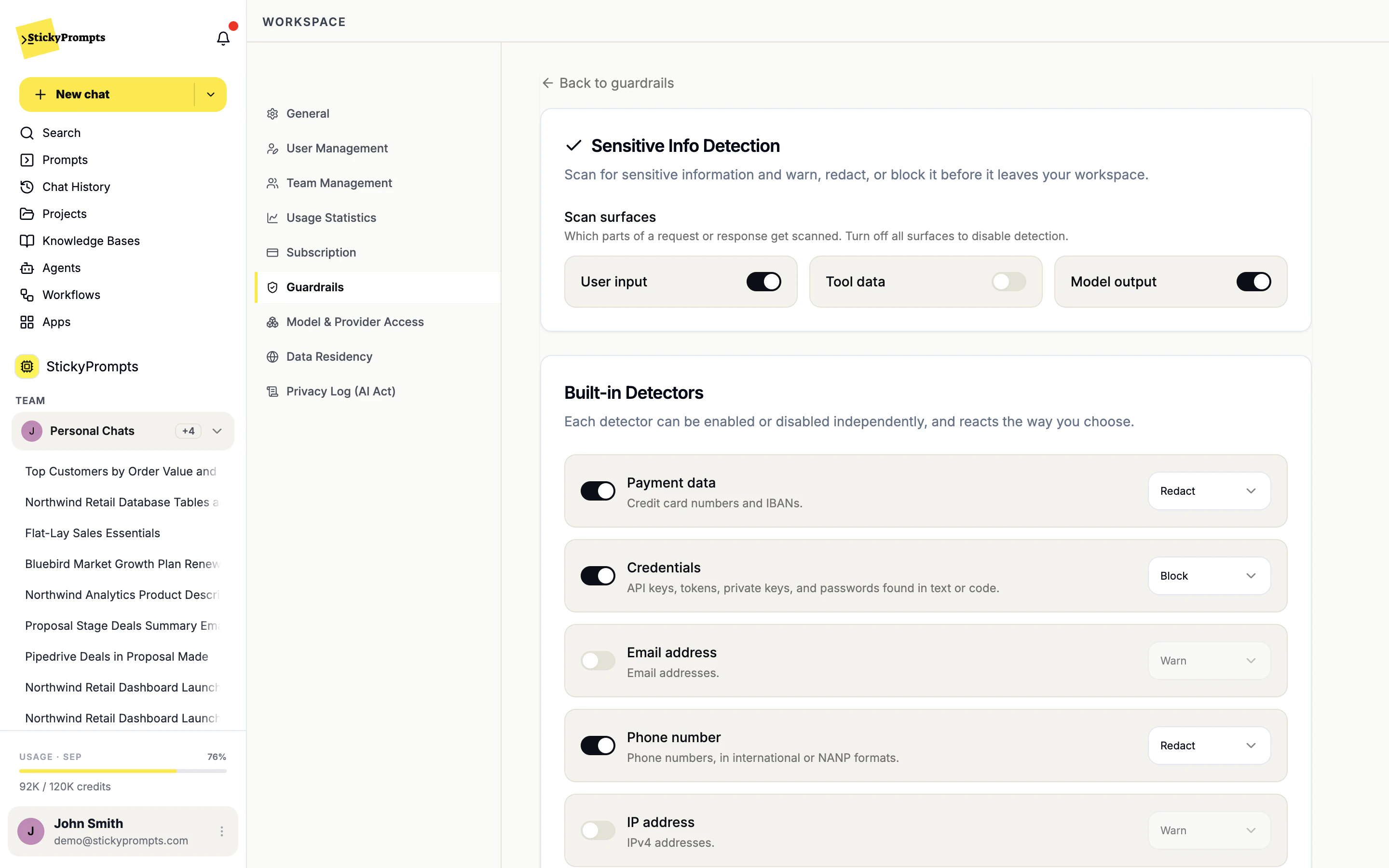
Choose the surfaces to scan and warn, redact or block per detector. The preview shows exactly what the model would receive before the policy goes live.
See the full product tourEvery trigger and change, exportable.
The privacy log lists every warning, redaction and block, and every policy change, with the time and where it happened. Filter it, export it, hand it to the auditor.
See the governance controls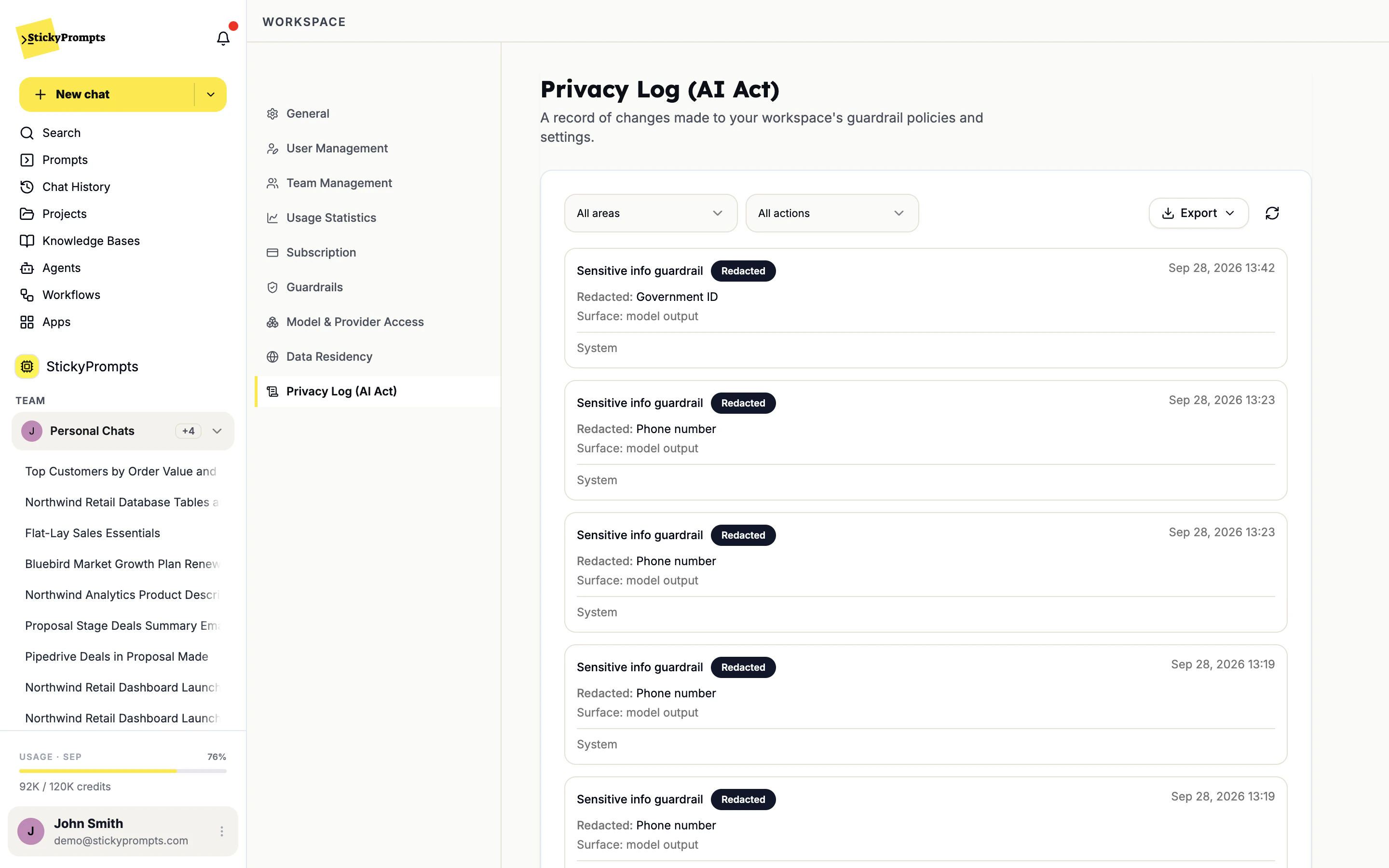
- One vendor assessment covers chat, documents, images, agents and workflows
- New capabilities arrive inside the controls you already set
- Guardrails scan what people type, what tools return and what models answer
- Zero-data-retention providers only, as one switch
- Data stored in the EU by default, with EU-served inference as an option
- Self-hosted deployment when the answer has to be 'on our own metal'
What IT & security teams ask us.
How quickly can we lock this down?
The controls are there from the first login, so the usual order is: restrict, roll out, then relax. Start with a narrow provider list, sensitive info detection set to redact or block, and integrations off. Each is a setting, and every policy change lands in the privacy log.
What does this do to our attack surface?
In the common case it shrinks: one governed workspace replaces an unknown number of personal accounts holding company data. For internal databases, StickyPrompts connects through an SSH jump host you control, with a key you authorise and from one published IP address you allow-list.
Can we run it entirely inside our own infrastructure?
Yes, as a self-hosted deployment, or as a private cloud with open-weight models on dedicated hardware. Both run the complete platform. What changes is who holds the keys and the metal.
By team
Try it on your own work before you commit.
Start free with a $5 trial balance. No card, no procurement marathon - bring one real task and see how far it gets.