Useful AI without sending patient data anywhere.
Clinical and research teams have obvious uses for AI and an obvious reason to be careful with it. The deciding question is usually architecture, not capability: can identifiers be stripped before a prompt leaves, and can the whole thing run where you choose.
- Clinical staff wanting AI help with documentation, and no safe route to give it to them
- Research teams blocked because the tool cannot say where data is processed
- Identifiers ending up in a prompt because redaction was left to the person typing
Six things healthcare & life sciences teams use this for.
Not an exhaustive list. These are the ones that come up first, and the ones that make the case for the rollout on their own.
Identifiers stay in the workspace.
Redaction runs before a prompt is sent, so personal identifiers can be warned about, replaced or blocked outright, per detector, with a record of every trigger.
See the full product tour- Open-weight models on infrastructure dedicated to you, on Enterprise
- Identifiers redacted before any external model is called
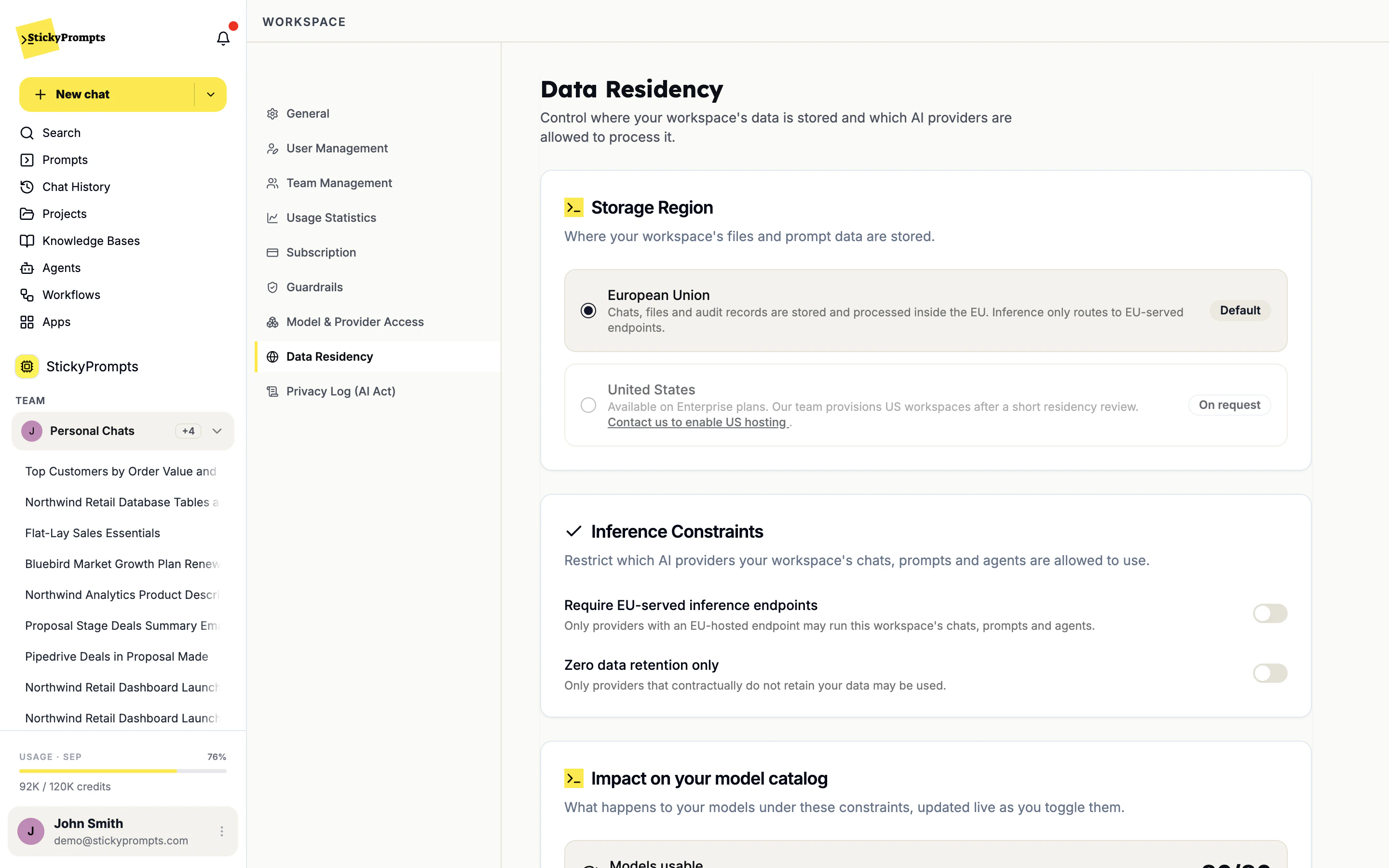
- Zero-data-retention providers only, as one workspace setting
- Data stored in the EU by default, with EU-served inference as a switch
- Knowledge bases with their own members, so research and clinical files stay apart
- Every redaction recorded in a privacy log you can export
What healthcare & life sciences teams ask us.
Can prompts stay entirely inside our environment?
Yes, on Enterprise. Open-weight models can be deployed on infrastructure dedicated to you, so a prompt never touches a third-party AI service. That is the private-models option, priced on compute rather than usage.
How does redaction work in practice?
Built-in detectors cover payment data, credentials, email addresses, phone numbers, IP addresses and government IDs, and you add your own patterns for record numbers and similar. Each can warn, redact or block, on what people type, on tool data and on model output. Redacted values reach the model as placeholders, and every trigger is recorded.
Is this validated for clinical use?
It is a general-purpose workspace, not a medical device, and nothing here is a claim of clinical validation. Where you use it in a clinical pathway, the validation and the human oversight are yours to design. The privacy log and chat history are there to support that.
By industry
Try it on your own work before you commit.
Start free with a $5 trial balance. No card, no procurement marathon - bring one real task and see how far it gets.