The Prompting Playbook: get reliably good work out of any model
Not a list of magic phrases - those stopped working. Twenty-five pages on what actually decides output quality: how to brief a model, how to diagnose a bad answer, how to test a prompt like a small piece of software, and how to turn the ones that work into assets your whole team can run.
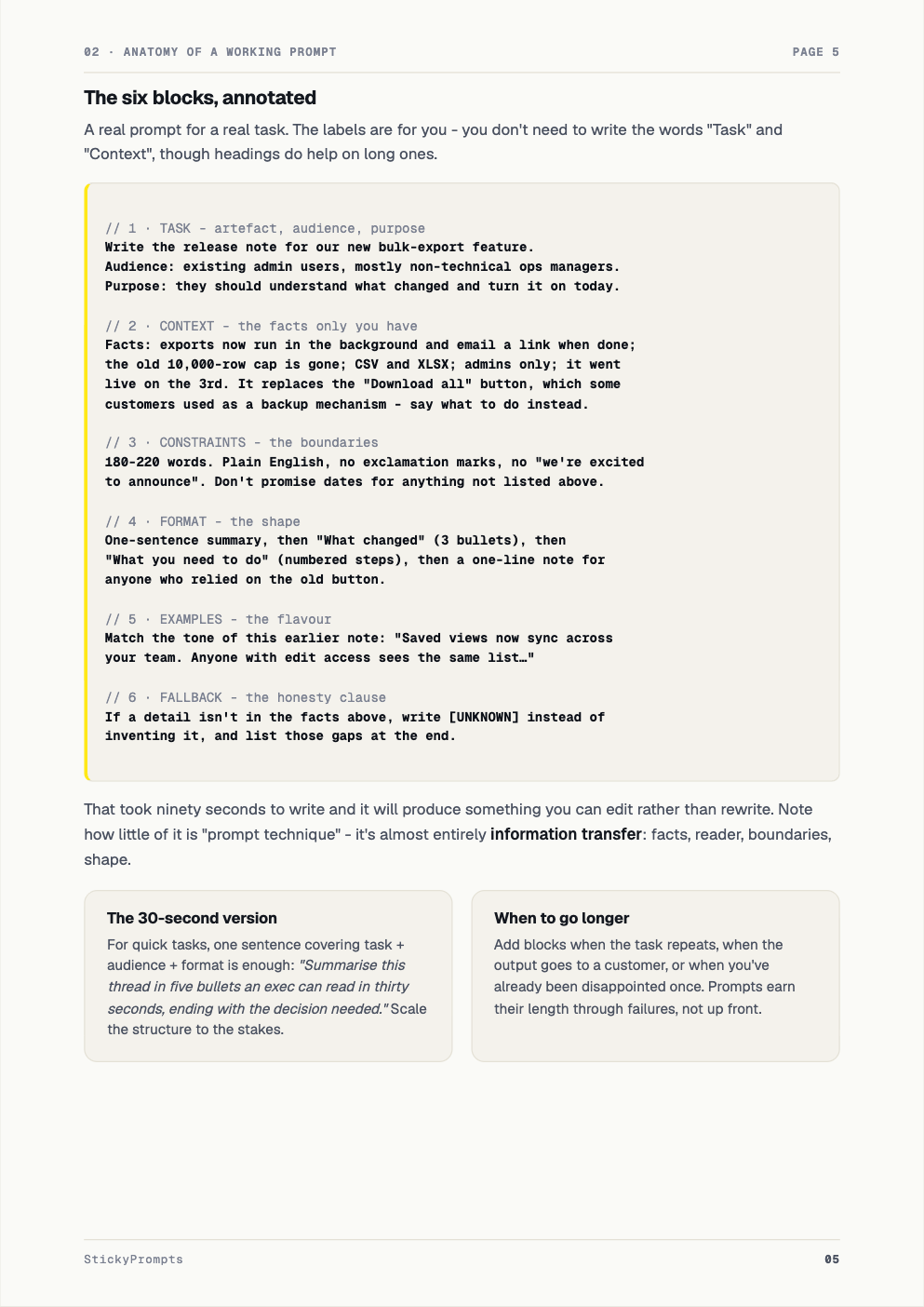
- The six-block brief, with a full annotated example
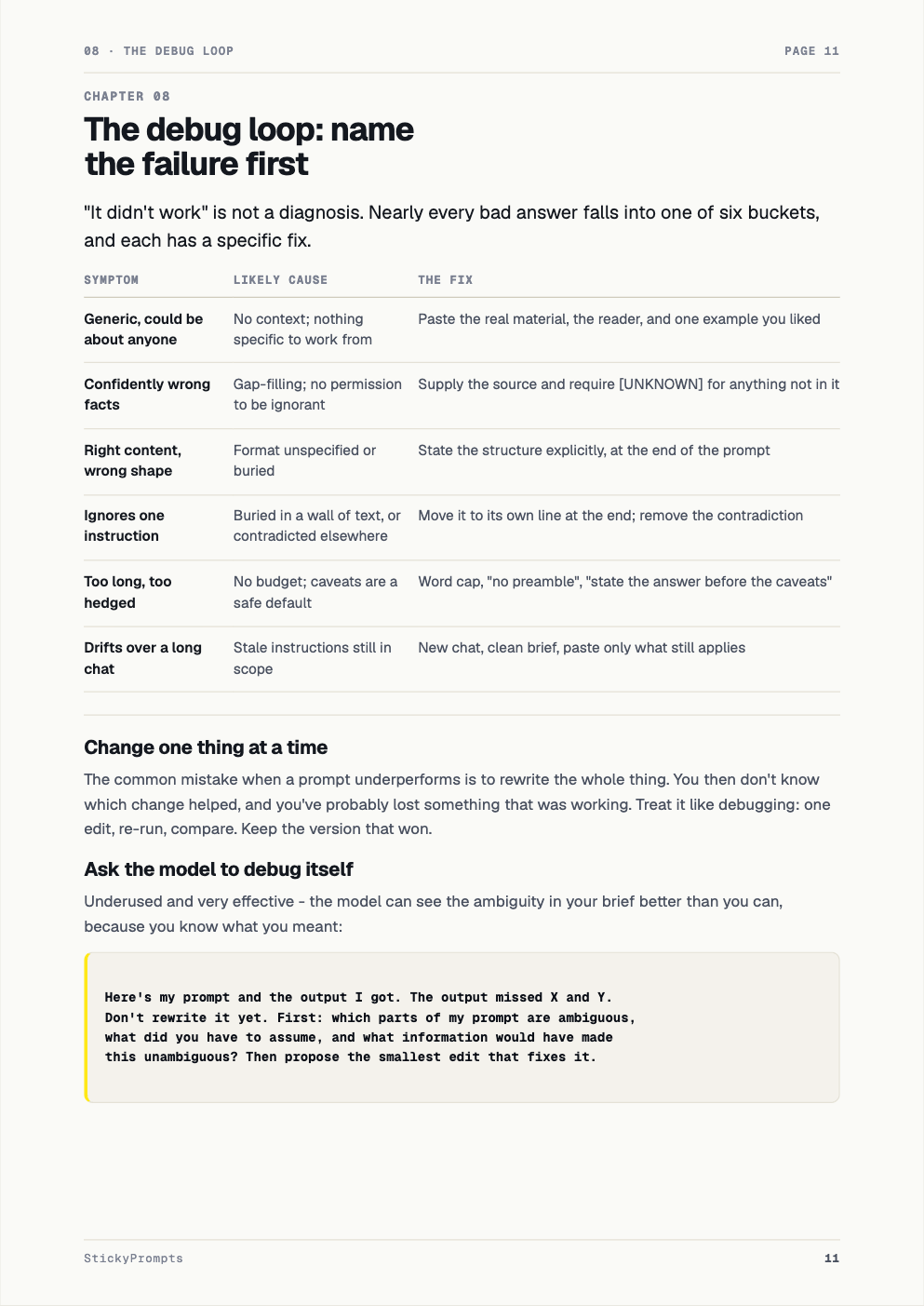
- A debug table: six failure modes, six specific fixes
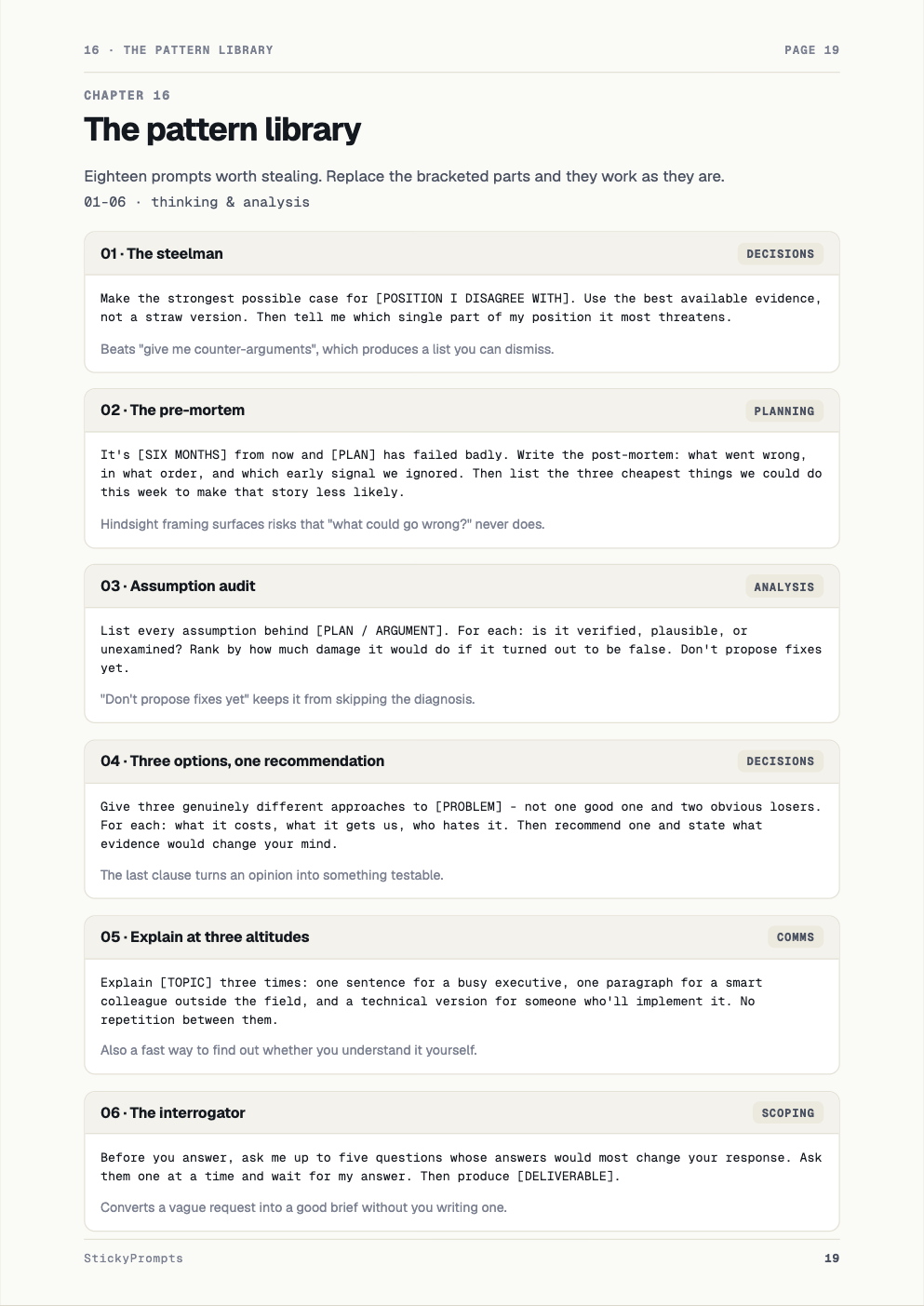
- 18 copy-and-paste prompt patterns worth stealing
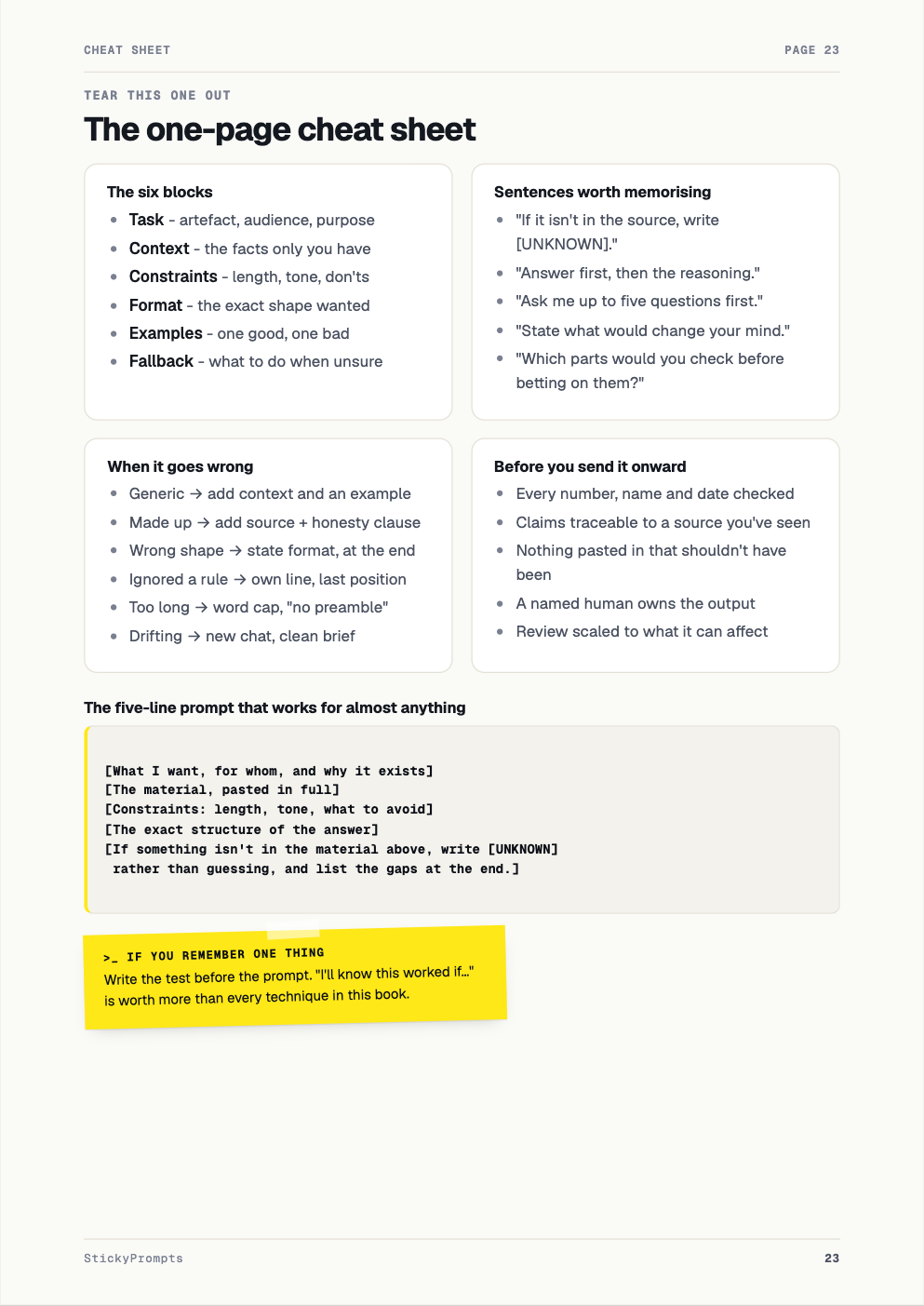
- A one-page cheat sheet and a plain-English glossary
Four pages, unretouched
These are screenshots of the actual PDF - generated from the same source, so what you see is what you get.
Seventeen chapters,
none of them padding
Short chapters you can read in an hour or raid one at a time. Every one ends with something to try on a task you already have open.
- 01 Prompting is specification Why phrasing tricks stopped mattering and briefs didn't
- 02 The anatomy of a working prompt Six blocks - and the one everybody forgets
- 03 Three rewrites, annotated The same request, before and after
- 04 Context What to put in, what to leave out, what never to paste
- 05 Examples beat adjectives How many, and why one bad example helps
- 06 Giving the model room to think When to ask for the working - and when not to
- 07 Output shape and structure Tables, templates, JSON that survives contact with software
- 08 The debug loop Six failure modes, six specific fixes
- 09 Testing a prompt A fixed test set and a checklist, in half an hour
- 10 From a prompt to an asset Variables, owners, versions, worked examples
- 11 Choosing the model for the job Matching the work to the model, not marrying one
- 12 Chains, tools and agents What changes once a model can act, not just answer
- 13 Grounding Making answers checkable, and where invention concentrates
- 14 Judgement and the human in the loop Scaling review to consequence
- 15 Rolling this out to a team Twelve weeks from private tricks to shared assets
- 16 The pattern library 18 prompts to steal, with the reason each one works
- 17 Anti-patterns The habits that feel like technique and cost you quality
Ideas that survive the first Monday
The six-block brief
Task, context, constraints, format, examples, fallback. When a prompt fails, the missing piece is nearly always one of them - so you stop guessing and start checking.
The honesty clause
One sentence that turns silent invention into a visible to-do list: “if it isn't in the material above, write [UNKNOWN] and list the gaps.”
The debug table
Generic, made up, wrong shape, ignored a rule, too long, drifting - each symptom mapped to the specific edit that fixes it.
The team playbook
How the good prompt in one person's chat history becomes the version everyone runs: variables, owners, versions, and a test set that catches regressions.
Take the playbook. Share it with the team.
One PDF, no drip campaign, nothing to install. The chapter on turning prompts into shared assets is the one most teams wish they'd read six months earlier.
The best prompt anyone writes should be the one everyone runs.
StickyPrompts is one governed workspace for every model, prompt, document and automation - with a shared library where the good prompts live, versioned and owned.